
What a Sandy Resident Lookup Can Check
The records below answer different questions. A sound resident lookup keeps the question, date, custodian, and role beside the name instead of merging every hit into one profile.
| Record | What It Confirms | Where | Access |
|---|---|---|---|
| Parcel card | Assessed owner and parcel facts | Salt Lake County Assessor | Free public search |
| Voter registration | Public registration fields and participation history | Utah voter search | Protected fields withheld |
| Court record | Public case history and filings | Utah Courts Xchange | Guest; images may cost |
| Vital index | Birth, death, marriage, or divorce lead | Utah OVRS and State Archives | Certified access restricted |
| License/entity | Professional or business record | Utah Commerce | Lookup or paid request |
Start with the source that matches the clue. An address points to the Assessor and Recorder. A court question belongs in Xchange and the courthouse route. A family-history question may begin with the State Archives birth index, County Clerk marriage records, an obituary, or the University of Utah directory collection.
Read a Utah Court Result Carefully
Sandy Justice Court is listed at 210 W Sego Lily Drive, Sandy, UT 84070, phone 801-568-7160. Xchange covers district and justice case information, with public documents filed since July 1, 2010 available through its repository. Most district courts were using CORIS by the end of 1998, but justice-court conversion dates vary and older converted cases can have less data.
The inspected portal visibly presents Guest, Pay Now, Login, and Get Started paths. Exact field order, result columns, pagination, and export controls were not fully exposed in static research, so do not promise a field that the live form does not show. Public results can include case history, minute entries, hearings, judgments, orders, decrees, and letters of appointment. Sealed, expunged, juvenile, adoption, private civil, and other protected classes may be absent.
If the public index is not enough, use the Utah court-record request route. It covers existing records, classification review, and format choices. The research lists 15 minutes of staff time as free, then $15 per hour, with separate costs for paper, electronic media, audio, video, fax, email, and certified copies.
Anchor a Name Before Calling It a Match
Same-name collisions are common in a growing Salt Lake Valley city. A name plus ZIP is weak. A name plus parcel, street, age range, middle initial, spouse or parent, case number, license number, or dated newspaper item is stronger. A resident lookup should report “not found in the public interface on the search date” when the result is empty.
- Write the exact name, spelling variants, middle initial, and known Sandy or Salt Lake County address.
- Use the Assessor to obtain a parcel ID, owner label, legal description, and as-of date when an address is known.
- Compare the name in the Utah voter search, keeping in mind that at-risk records are withheld.
- Search Xchange and read the court classification before describing any result.
- Use a vital index, newspaper image, directory, license, or official request as a second source.
- Save the custodian, source URL, record role, date, and uncertainty note.
- Docket
- A court’s running case record, including filings, events, and hearing entries.
- Index
- A name-based finding aid; it may point to an image or record that has separate access rules.
- Certified copy
- An official copy issued by the custodian with a certification, not a screen view or index hit.
Vital Records Have Separate Access Rules
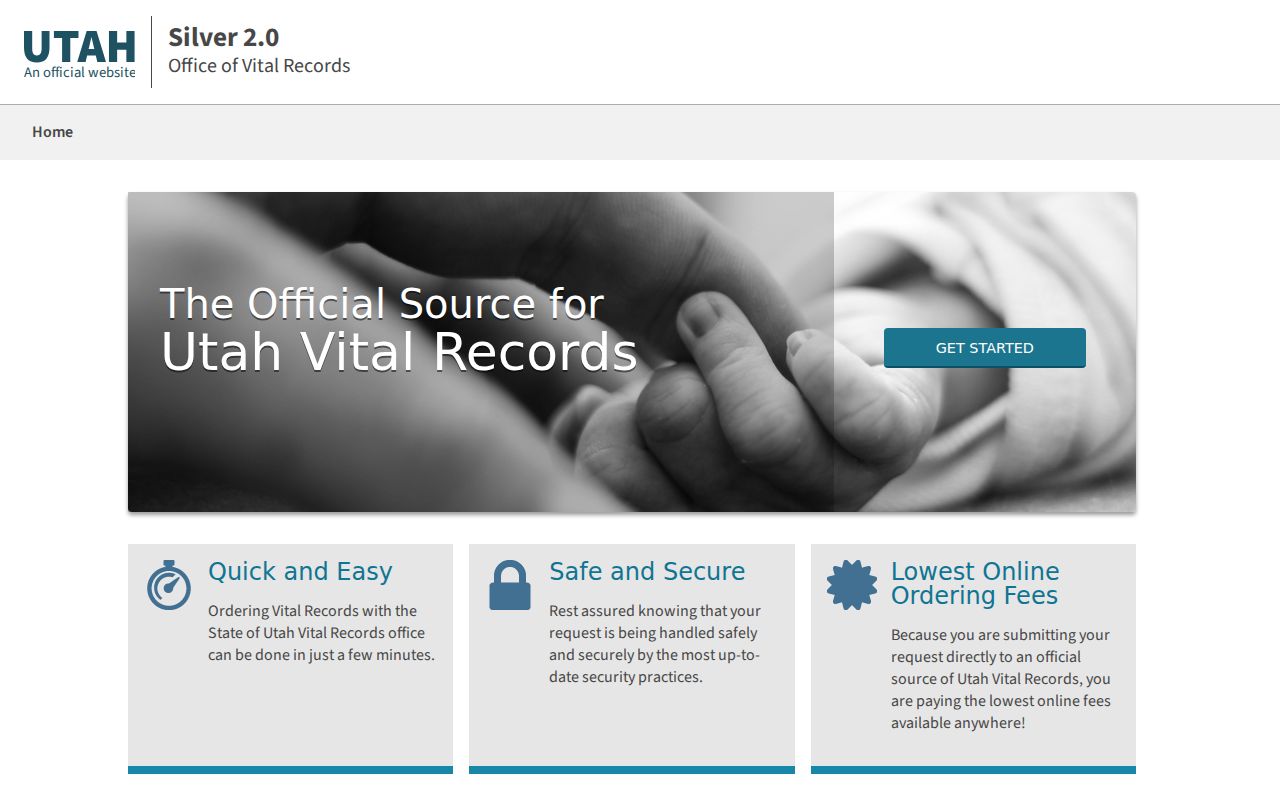
Utah OVRS is the primary custodian for modern Utah birth and death records. Its birth application asks for requester identity and contact, subject name, date and place, parents, relationship or eligibility, copies, delivery, ID, payment, signature, and date. One primary ID or two secondary IDs may be accepted under the office instructions. The vital-records portal is the correct route for a qualifying certified request, not a general public name search.
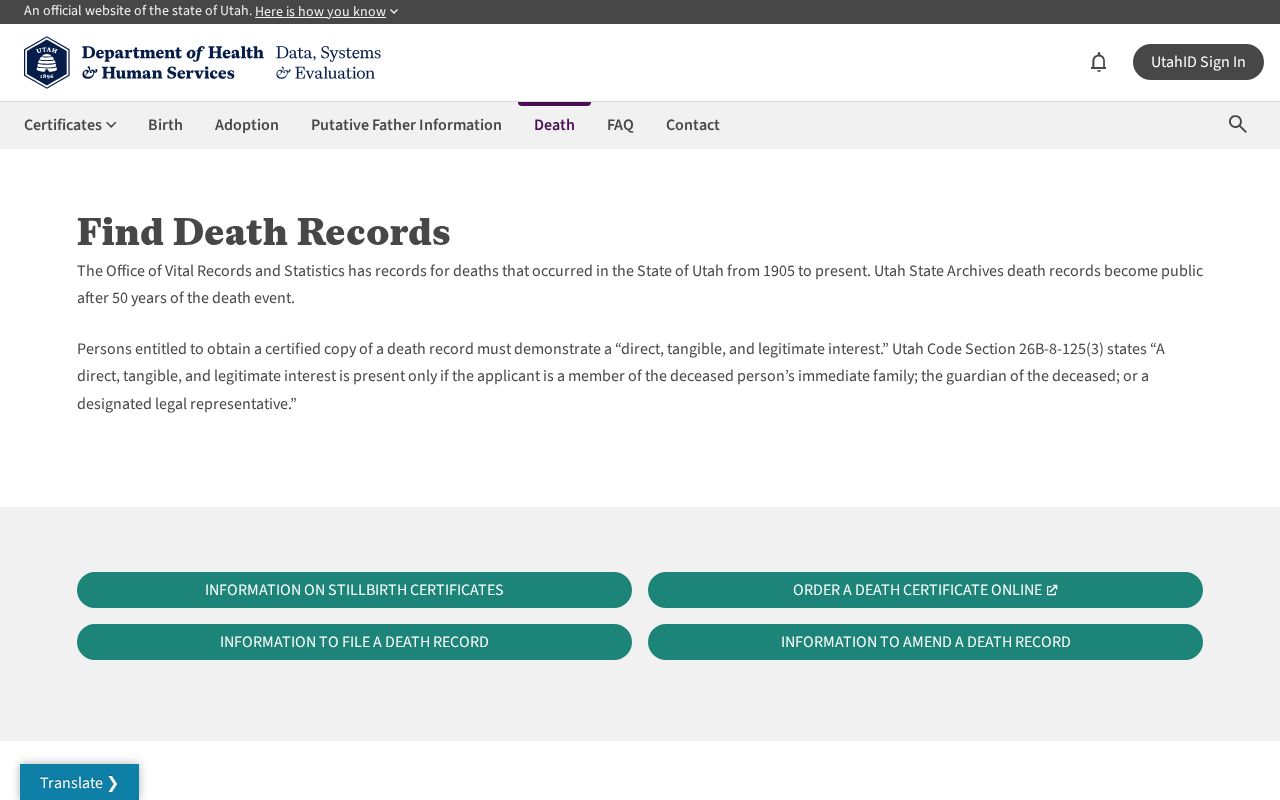
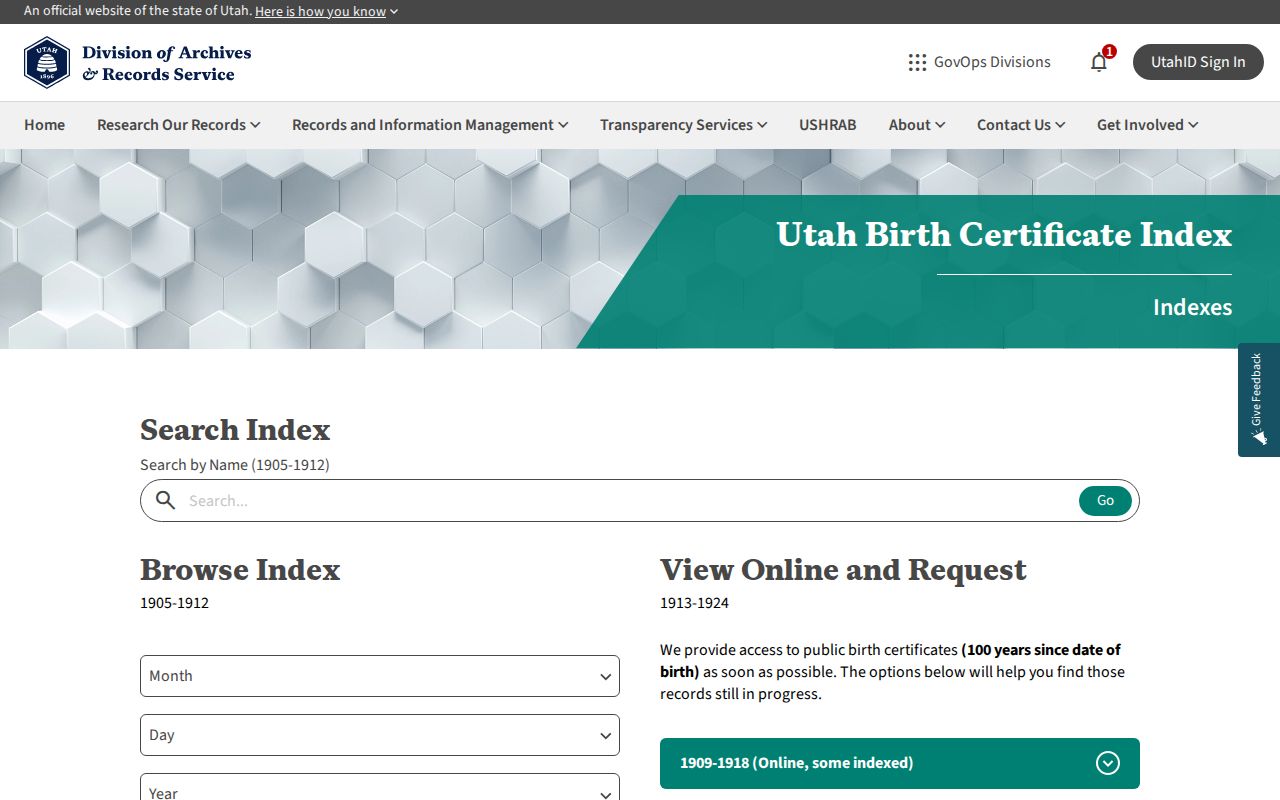
Death records are held from 1905 forward and become public in the Archives after 50 years. Before then, a certified copy needs a direct tangible and legitimate interest or a listed family, guardian, legal, or statutory basis. The State Archives birth index offers a different route: name search for 1905-1912, a partial 1909-1918 index, Soundex for 1904-1924, and request or transfer notes for later periods. An index can show child name, date, place, and parents’ details without being the certificate.
Salt Lake County Clerk handles marriage licenses and copies. A person can obtain their own certified license with ID in the documented channels. Another person’s certified copy requires a GRAMA request and eligibility review. County marriages before 1940 are a County Archives research target, and the state divorce abstract route lists 1978-2010 coverage. The Utah Adoption Registry is a voluntary mutual-consent path for adult adoptees, adult siblings with a common birth parent, and birth parents.
Know What a Public Voter Search Shows
Utah’s voter form displays First Name, Last Name, Date of Birth, Street Address, City, and Zip. Public registration information can include a name, physical and mailing address, age range or year-of-birth presentation, party affiliation, and vote history showing which elections a person participated in. It does not show how the person voted.
DOB, driver-license or state-ID information, Social Security number, email, and phone are universally protected. At-risk voters can be withheld from the public, parties, and candidates. Utah Safe at Home provides a substitute address and mail forwarding for eligible survivors who fear danger. Do not use another record source to reconstruct an address that a protected program has withheld.
The statewide file described in the research included legal name, voter ID, age range, full residential address and unit, county, districts, party status, activity status, last update, and vote history. Its listed $1,050 price and March 8, 2026 data date were time-sensitive. County lists and who-voted or absentee reports follow separate routes and fees. Confirm current availability before ordering.
Separate a License From a Residence
Utah DOPL Licensee Lookup supports name and profession or license-number modes. A name search can use “Beginning with name” or “Containing name,” and a profession selector narrows the state licensing categories. A license-number search accepts a core number and an optional four-digit identifier. Results typically show Licensee Name, City, Profession, License Number, and Status.
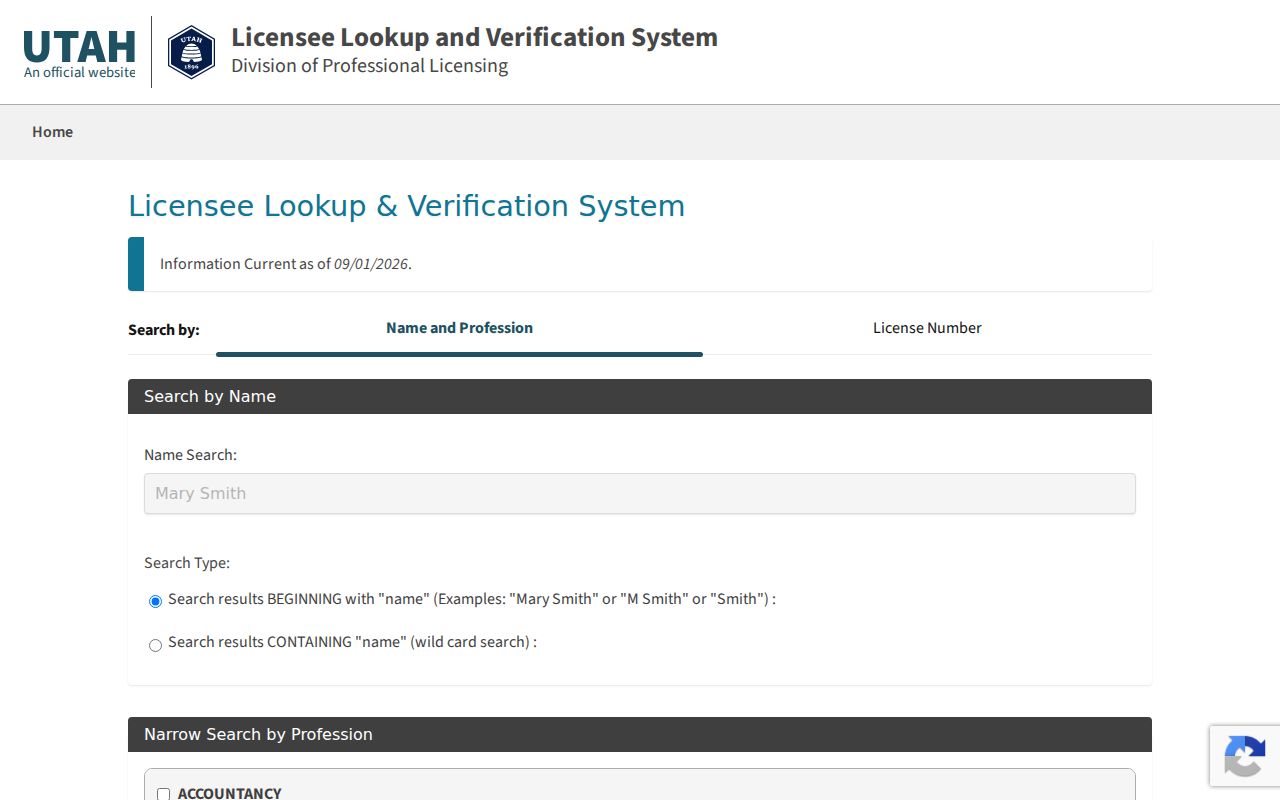
DOPL says its data was current as of September 1, 2026 in the research capture. A lower-level credential can be expired or superseded while a higher-level license is active, so keep the credential level and status together. Public details suppress address, phone, and email under the cited Utah provisions. Bulk public-license data can filter by ZIP, dates, people or organizations, status, and profession, with listed fees of $5 for the first 200 records, $0.03 for each additional record, or $0.01 per record for a full list.
The Utah Business Registration portal has Search Business Entity Records, Name Availability, Authenticate Certificate, and Help options, with Utah ID login in parts of the flow. A registered-agent result can show entity name, entity number, agent type, address, and status. A registered agent may be an individual, commercial agent, or attorney, and a PO Box is a mailing address rather than proof of a physical location.
Use Sandy’s Historical Sources for Context
The County Library genealogy page lists Ancestry Library Edition on-site, Utah Digital Newspapers, Utah NewsSearch, and state archive resources. Sandy Library is at 10100 S Petunia Way, Sandy, UT 84092, and the County Library customer-service number is 801-943-4636. Utah Digital Newspapers has more than one million searchable pages. Search the exact name and street, then inspect the original page because OCR can misread a surname.
The University of Utah Utah City Directories Collection has 232 digitized items and organizes material by residents, streets, businesses, organizations, institutions, publishers, and geographic arrangement. R.L. Polk runs in 1921, 1930, 1933, and 1939 include Sandy or suburbs. Suburban volumes from 1974, 1979, and 1980 continue the trail. For a full historical reading method, use the Sandy Directory Book; for a modern address chain, use the Street Directory.
Request the Existing Record
Salt Lake County NextRequest and its GRAMA form are useful when the search box is incomplete. Describe the agency, exact record series, name or parcel, date range, inspection or copy choice, and contact route. The form includes fee-waiver language under Utah Code 63G-2-203(4), subject and requester ID fields where applicable, consent, and an instruction not to include a Social Security number. GRAMA provides existing records only; it does not require an agency to create a new resident list.
Utah Archives guidance cites a response no later than ten business days under Utah Code 63G-2-204(3), or five business days for qualifying expedited requests. Actual reasonable costs can apply, and a county prepayment over $50 may be required. Keep the request number, submission date, exact wording, fee authorization, response, redactions, and appeal deadline with the lookup notes.
Legal Limits on a Sandy Resident Lookup
Utah public records have different access clocks and classification rules. Vital, court, adoption, voter, and criminal-history information may be private, restricted, sealed, expunged, or limited to a person with a lawful relationship. The Utah Consumer Privacy Act concerns data held by covered businesses and does not erase a government record. A public result is not identity proof, and an empty interface is not proof that no record exists.
Lawful use. A Sandy resident lookup is for personal, lawful research, family history, reconnecting, and civic understanding. Do not use records to stalk, harass, monitor, intimidate, or harm anyone, and never work around a protected-record program.
For a person who may be an heir, birth parent, classmate, or former neighbor, use the official program suited to that relationship. The Utah Adoption Registry uses voluntary mutual consent. A family-history search can use Archives indexes and newspapers. A current street question belongs in the address workflow, where the record role stays clear.